I made it to Jibo-myeon, arriving a bit after 6:20 p.m. after leaving Sangju and the Bobos Motel at 5:30 this morning (excluding breaks, my average pace was 3.1 kph—better than the previous day). I'm in the Gangnam Motel (W50,000 a night), and after looking forward to a hot dinner ordered via Yogiyo, I discovered that Yogiyo doesn't work where I am, but my motel room does have a list of food establishments with phone numbers. Or, assuming I finish this post quickly enough, I can put my shoes back on and walk a half mile into town and either hit a restaurant or grab some stuff from the lone convenience store. But frankly, I'm too tired to do more than tap this tiny cell-phone keypad, so I'm going to either order some food by phone or just wait until tomorrow to grab whatever I want.
Today's walk took several kilometers to get back onto the official path, but I ended up heading east into the sunrise. Sangju is not exactly a small city; it's famous for persimmons, which are hang-drying everywhere right now. As with many cities the world over, Sangju's vehicular traffic is busy by 6 a.m. I was happy to leave the city and find myself on back roads and quiet trails, but I did occasionally have to follow roads with cars passing by every few minutes. Overall, though, the situation wasn't bad or dangerous, not even on the bridges with no shoulders or bike lanes.
Lots and lots of farmland as I moved east toward Andong. And there was plenty of activity at those farms, even in November. Garlic and cabbage are still being grown, along with another leafy plant that I at first thought was perilla. A closer look showed I was wrong, and I still don't know what plant it is.
[NB, 12/18/25: It's probably a radish, or mu/무, a Korean daikon.]
I'm here at the Gangnam Motel for two nights. Friday morning, I'll mosey on over to western Andong, a 30K trek that I hope will be easier on the feet than today's walk had been. And finally, on Saturday the 15th, I'll do the final leg, a 28K segment to the Andong Dam.
While I'm at my current motel, I also need to wash my clothes again so that they won't be too stinky when I bus home on Saturday. But I guarantee that everything will get a thorough (re)washing once I'm back at my place, including yours truly.
Just two more legs to go. Enjoy the pics.
 |
| my second-longest day at 36K |
 |
| a bit northeast, but mostly east |
 |
| licking its lips at its own demise |
 |
| jinggeom-dari (footbridge) lit up for night crossings |
 |
the moon, Jupiter, Procyon, and Sirius
|
 |
| a resto for cabbies |
 |
| "sunrise" |
 |
| persimmons hanging out to dry |
 |
| view from a hill |
 |
| Don't eat the unripe ones. |
 |
| amazing sunset sky |
 |
| Gangnam Motel—where I am now |
VIDEO: How they make the giant marshmallows.
VIDEO 2: I was sure it was dried up and dead. Then it moved.
EPILOGUE: I ended up walking into town to visit the local convenience store, tired as I was. Step total now: 62,000. I tried calling the nearby Chinese place, but I called at 7:20 p.m., and the lady said they didn't take delivery calls after 7 p.m. With the universe's constant and consistent attempts to thwart me, I was worried that the convenience store would also be closed when I got there, but the gods were merciful, and the lady there said the store would close at 10 p.m.
PHOTO ESSAY
 |
| the licking cow: Yangpyeong Haejang-guk/양평해장국 |
Haejang-guk is considered one of Korea's more famous hangover soups. It has large chunks of clotted blood in it, which might sound gross to a non-Korean. But the soup tastes very good, and the clotted blood feels more like a species of tofu (dubu/두부 in Korean) than anything else.
 |
| retracing my steps to get out of town |
 |
| "Sangju Terminal" again |
 |
| passing the misters at 5:57 a.m. |
Having left for this 36K walk at around 5:30 a.m., I knew I'd be arriving in Jibo-myeon very late in the day, probably after sunset. I took that gamble because I knew I'd be staying an extra night.
 |
| jinggeom-dari, lit up |
 |
| that sculpture as seen from behind |
 |
| a shwimteo with what appears to be a table in the middle |
 |
| top to bottom: moon, Jupiter, Procyon, Sirius |
 |
| You can see the lightening sky ahead. |
 |
| about to go through that gate |
 |
| Gyeongsang 1st Gate |
 |
| pastoral scene inside the gate's tunnel |
 |
| another scene |
 |
| almost through |
 |
| Sambaek Agricultural Rural Theme Park (삼백 농업 농촌 테마공원) |
 |
| We're past dawn now. The sky is well lit. |
 |
| Another dog sees me too late and starts barking. |
 |
| a "driver's restaurant" (gisa shikdang/기사식당) primarily for cabbies, but the general public may enter |
 |
| Daehan Christian Presbyterian Church |
The "flavor" of Presbyterianism in Korea strikes me as a bit more fundamentalist-inflected than PCUSA back home. Of course, American conservatives would say that PCUSA has been taken over by woke liberalism, so maybe I'm more prone to see fundie Christianity where there is none.
 |
| It's hard to tell, but I'm gesturing left. |
Going left is where Naver is telling me to go, and in general, it's unwise to dispute the Naver Map app. This route will make me out of town—not necessarily out of Sangju, per se, but out of the more heavily urbanized part of town. The population density and civilizational density will both thin out, and there will be more farmland and some villages. Ultimately, I'll end up leaving Sangju altogether and continuing on to Andong. But at this point, I'm entering a kind of no-man's-land: I'll be out of urbanized Sangju but not quite at the Nakdong River bike path, which I have yet to get back on (so I'm still off-piste). It's going to be a few kilometers before that happens.
 |
| up a slight rise |
 |
| et voilà—farmland not even a kilometer from that left turn |
 |
| looking east toward the sunrise |
 |
| myo on someone's property |
 |
| with flowers, no less |
 |
| shrine (back view) |
 |
| I think the shrine is associated with that partly concealed building on the left. |
 |
| the shrine's front |
 |
| mystery building, side view as I keep walking forward |
 |
| mystery building, front |
 |
| None of the characters on the horizontal plaque over the front door say "temple." |
I think this could be some sort of ancestral shrine, though, judging by the jong/종/宗 character. The hanja for temple (사/sa) is 寺.
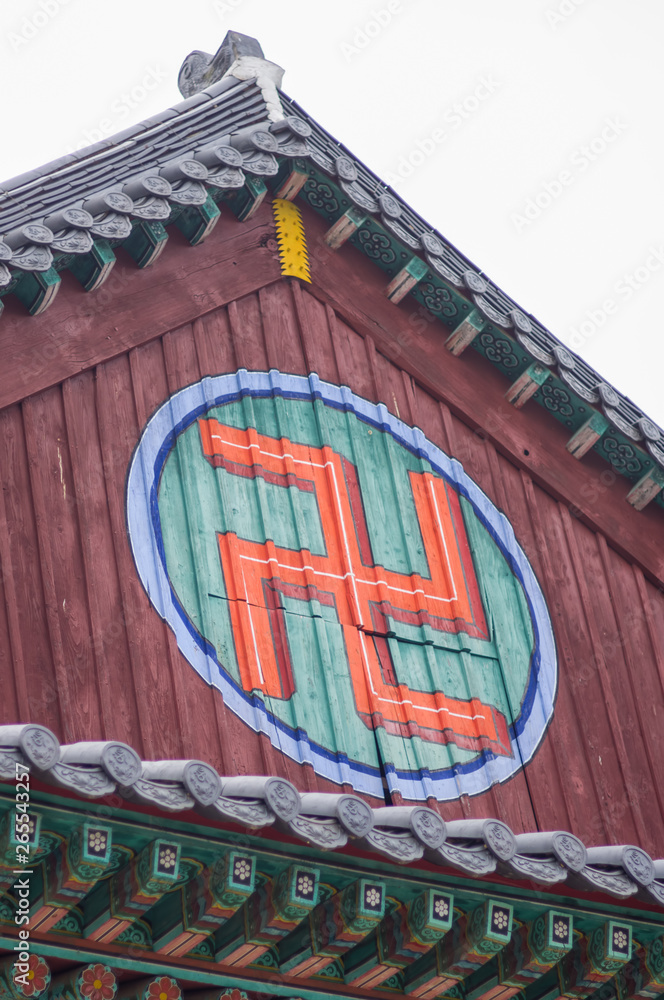
How do I know it's not a Buddhist temple? Buddhist temples are usually recognizable by their iconography: you'll see lotus-leaf images, three dots symbolizing the "three jewels" (sambo/삼보/三寶) of Buddhism (Buddha/불/佛/bul, dharma/법/法/beop, sangha/승/僧/seung—the teacher, the teaching, the religious community), maybe a huge swastika (seen in Japan, too), hanja saying "temple" somewhere out front, etc. Sometimes, the temple itself might feature paintings on its outer walls depicting moments of the Buddha's life or moments from didactic stories (like the Ten Ox-herding Pictures from Zen), and if the temple is big enough, you'll easily recognize that the "campus" of a Buddhist temple is divided into main buildings and outbuildings—a dharma hall, minor halls, shrines, a refectory, monks' sleeping quarters, etc. Bigger temples will also feature an entrance where you have to step over a watercourse (creek, stream) as well as an ilju-mun (일주문/一柱門, lit. one-column gate), where practitioners will normally stop and do a palms-together bow called a hapjang/합장/合掌. Temple color schemes can vary, but most temples will be predominantly red-brown and blue-green (see here).
 |
| two fat and delicious-looking geese |
 |
| Enjoy Christmas, you two. |
 |
| The parade of gloves begins— |
 |
| —and ends just as quickly. |
 |
| dilapidation and more cracked concrete to my right |
 |
| This stop is Heonshin/헌신, named for the precinct of Heonshin-dong. |
 |
| the sign for Heonshin-dong |
 |
| what appear to be huge, king-sized myo in the distance |
 |
| Normally, the tumuli are that big when they're for someone famous or important. |
 |
| faux sunrise in progress |
 |
| a stand out front for selling cucumbers |
 |
| those huge myo |
 |
| Heonshin 1st Precinct |
 |
| Another small arfer greets me noisily. |
 |
| Cow house! Hello, ladies. |
 |
| another gas-release pipe and tower |
 |
| in context |
 |
| so much construction |
 |
| Byeongseong Church |
Remember, in romanized Korean, the eo represents a sound between "aw" and "uh," so pronounce Byeongseong like "byuhng suhng," with a short-U sound. My Korean-fluent boss used to say that the eo is supposed to be like the sound of eo in George. Think of Seoul: Seo + ul = "saw + ool."
 |
| Byeongseong Church, closer |
The hanja for Byeongseong could be several things. A plausible rendering might be 炳星, or shining star. So: Shining Star Church, perhaps a reference to the star of Bethlehem.
 |
| the sticks... or maybe the Styx? |
 |
| At least I'm on a bike path of sorts. |
 |
| so many structures I simply don't understand |
 |
| gravesite |
 |
| up close |
 |
| vaguely east, toward the rising sun |
 |
green font: safety first
red font: construction
black font: (go) slowly
| | |
 |
| more myo, more modestly sized |
 |
| up close |
 |
| a road I will not go down |
 |
| faux sunrise |
 |
| a home I always photograph when I pass by |
 |
| another "safety first/construction/slowly" sign |
 |
| swinging up and left |
 |
| 8.5K back to the Sangju Bus Terminal; I haven't gotten far by 8:02 a.m. |
 |
| bridge in the distance |
 |
| a shwimteo where I will be sitting |
The morning had warmed up enough that I no longer needed my chemical hand-warmers.
 |
| across the bridge |
 |
| the "river" that the bridge spans |
 |
| the Byeongseong Bridge (Byeongseong-gyo/병성교) |
Okay, so "Byeongseong" is a regional name. There goes my theory. The church I'd seen is named Byeongseong simply because of its location, not for any religiously symbolic region. So it's like "First Church of Arlington" as opposed to a more theological name like "Grace Methodist Church."
 |
| starting across |
 |
| and right away—a glove! |
 |
| Okay, maybe this is more of a river. A small, skinny, scrawny river. It could still be a creek, though. |
 |
| Your thoughts on nomenclature? |
 |
| small shoulder, but not much traffic at 8:14 a.m. |
 |
| a glove that apparently got yanked off (or as they say these days, yeeted) |
 |
| a long, lonely road |
 |
| ...but at least there are marshmallows. |
 |
| shrine in the fields |
 |
| behold |
Multiple religions coexist more or less peacefully on the peninsula (with Christians being the most aggressive proselytizers), but on the whole, the Korean population is becoming less and less institutionally religious. There is a term for people who are not part of any religious tradition: mugyo/무교/無敎. The term is not really the equivalent of terms like spiritual not religious or atheistic, but conceptually, it includes anybody and everybody who's not on a traditional, established religious path, including rational-materialistic atheists. In some ways, it's a cousin of the Christian term unchurched in the sense that it simply means "having no path" as opposed to "actively anti-religion" or "committed to a philosophy of skepticism." But whereas unchurched, being a Christian term, has a vague connotation of spiritual wandering (an implied hope of eventually settling on a church), mugyo is semantically open enough to include people who are already settled in their "no-ism-ness." And settled is not the same as committed.
 |
| With relief, I hop onto a sidewalk. |
 |
| hillside with shrine and graves |
 |
| ...the dead! |
 |
| AI's rendering: "Gyeongsangbuk-do Provincial Monument: Tomb and Stele of General Jeong Giryong" |
Even though I see the hanja characters for Shinto (神道), this tomb has nothing to do with Japanese religion, so read 神道/시도/shindo as "god-way," and as part of a larger expression, 神道碑/신도비/shindobi, meaning "stele, tombstone, tablet," etc. As the Chinese scholar Victor Mair pointed out, dividing a word into its component parts can lead to ridiculous interpretations of that word's meaning. For instance, the word airplane contains both air and plane, but an airplane is neither air nor an abstract geometric plane. There was a period, in recent years, when English speakers would go on and on about how, "in Chinese, the word for crisis—危機—was composed of the characters for danger and opportunity, and that we should somehow take a moral lesson from that." Mair's analysis would be, "Just translate it as crisis," keeping in mind that no translation is ever totally exact.
 |
top line: construction in progress
second line: no entry
first line below the circle: please detour |
There's a barrier strung up at this point. Cars and bikers can't get through, but—as I reasoned—walkers can step over the barrier and keep going. So that's what I did, thereby risking being yelled at by some old guy who takes pleasure in yelling at people.
 |
| Before I move on, though, there's this interesting fungus. |
 |
| a strawberry-selling booth, not currently open (and since it's by the barricade, not opening for a while) |
 |
| I look over and see air houses, fields, and a farm road. |
 |
| Here—a shot of what blocks me. But not for long. |
Luckily for me, getting past the barrier requires no athleticism, or I'd be fucked.
 |
| On we go. |
 |
| another big, fat myo |
 |
| with lots of little graves |
 |
| Paranoid, I walk along this cordoned-off section, expecting to be caught by somebody. |
 |
| the village of Samdeok-ni (삼덕리/三德里), the village of "three virtues" |
 |
| so many "three virtues" to choose from |
The "three virtues" in question could come from any number of traditions; I'd have to ask someone in the town which triple is meant. It could be the classic Christian faith, hope, love; AI offers honesty, strength, gentleness as well as wisdom, benevolence, courage.
 |
| I'm now out of the cordoned-off section, no worse for wear. |
 |
| This is completely changed from last year. Construction is ugly before it gets better. |
 |
| "Don't worry, ditch... one day soon, you'll be a creek." |
 |
| the tree with the deer statues or sculptures or whatever the right word is |
 |
| Bambi's parents... about as real as Bambi |
 |
| shwimteo off to the side (and is that a movable table inside it? so you need to bring chairs?) |
 |
| Go, Grandma! putt-putt-putt... |
 |
| Another arfer sees me too late. |
 |
| Here, the water wheel is off. |
 |
| persimmons a-dangling |
 |
| those lovely, distant mountains |
Fellow Virginians will have noted the strong resemblance between Korean mountains and the Appalachians, the Shenandoahs, etc. In both cases, we're talking about ancient, ancient mountain ranges that have had millions upon millions of years to erode—quite unlike the very young, tall, and sharp-edged Alps, Rockies, and Himalayas. This is where it's at.
 |
| through the neighborhood |
 |
| looking left |
 |
| The gloves obliquely mark my path forward. |
 |
| in context |
 |
| maybe its green-rimmed partner |
 |
| Both gloves, together, tell a story. |
 |
| I imagine the moss looks much better, more textured, when you click to enlarge. |
In case you haven't figured it out by now, clicking and enlarging a picture on this blog lets you see it more clearly: the un-enlarged pic you're seeing right now, unclicked, is merely a thumbnail, so the graphics quality is lower. So—click to enlarge, then right-click the enlarged pic and select "open image in new tab" to see the image at full size. If you want. Full size is too much for most people.
That's what she said.
 |
| strangely free of horse apples |
 |
| to be picked up by the baler |
 |
| that lone persimmon |
 |
| morning sun at 8:57 a.m. |
 |
| I'll treasure the sidewalk as long as it's here. |
I'm normally not a huge fan of sidewalks, but a sidewalk feels more apropos here.
 |
| apple trees |
 |
| Koreans grow what Americans know as Fuji apples. In Korea, they're called Busa/부사. |
 |
| I normally love cairns, but this arrangement is too contrived. |
 |
| Sannaedeul Farm |
 |
| hangari/항아리—clay pots for kimchi or gochujang |
 |
| up a slight hill I go |
 |
| and up some more |
 |
| ah, sweet memories |
The first time I walked the Sangju-to-Andong path a few years ago (after doing the loop trail around Jeju Island), I went along a slightly different route that started at the Sangju Bus Terminal, but I did stay overnight at this motel, the Gyeongcheondae, as advertised on the vertical sign at right. The sign across the top advertises the Gyeongcheondae Restaurant, which specializes (according to the parenthetical) in Korean food and tofu/dubu.
What I wouldn't do for some haemul pajeon or gamja jeon.
 |
| But I'm not stopping here today. Moving on... |
 |
| Choices, choices... but I go straight. |
 |
| Soon, you'll see why there are all these references to Gyeongcheondae. |
 |
| still moving slightly uphill |
 |
| chair, exiled |
 |
| no hope of detailing or reupholstering |
 |
| a rare sight: a shwimteo, but with windows |
 |
| I think that's a giant solar panel on top of the house. |
 |
| ...and here's a solar panel doubling as a garage of sorts. |
 |
| Aha. Here we are. |
When I popped out here the first time, in 2022, I was weirded out for a second. By 2022, I had hiked the Four Rivers trail three times, so I was used to encountering this gateway, which is a park entrance, from the other direction. Because of the nature of the Four Rivers trail, I would normally enter the park itself in order to continue south, eventually to Busan. In 2022, however, I was seeing this park entrance from the opposite side, and I would not be entering the park. The whole thing felt weird and surreal, and it's taken a long time for my heart to understand what my head knew intellectually: Of course the Four Rivers and the Nakdong paths have to intersect somewhere! This year, though, marks my third time doing this part of the path, so I'm used to this sight now.
This also marks the point where I finally get back onto the Nakdong River trail after having been off-piste this entire time. It's something of a relief. I think the Bobos Motel, where I started this morning, is about 12 or 13 km from this point. That's how far away from the proper path I was. From here on in, I'll be on the correct bike path except for when I hop off to hit motels, and those detours won't take me more than a couple kilometers off the proper path.
 |
| the distinctive gateway/entrance to the park and Gyeongcheondae |
 |
| Were I heading to Busan, I'd swerve right, right here. |
 |
| a peek up into the park I'm not entering |
 |
| For the moment, I'm heading Seoulward, but that's going to change soon. |
 |
| Gyeongcheondae bus stop, with Mukha ahead and Sangju behind |
 |
| GYEONGCHEONDAE!! |
 |
| (looking left) equestrian park across the way, but no smell of horseshit |
 |
| (looking right) the gate to a Confucian academy I have yet to explore |
 |
| a "seminar building/hall" |
 |
| banner: "Sangju, from Prehistoric Times to the Joseon Era" |
 |
| looks like a nice museum campus, but I've never visited |
 |
| older Chinese script: Sangju Museum (Sangju bakmulgwan/상주박물관) |
 |
| passing another part of the equestrian park |
 |
| the part with the distinctive sculpture |
 |
| tucked-away shwimteo |
 |
| more of those strategic pines, there to lend dignity and gravitas |
 |
| On I go. |
 |
| If I had a nerdy girlfriend, this might be a nice spot for a date. |
 |
| "Sangju Museum" (Sangju bakmulgwan), in hangeul this time, not hanja |
 |
| They look startled. |
 |
| rectangular, old-school shwimteo |
 |
| "Agricultural Culture Center" (awkward phrasing?) |
 |
| hangari on display |
 |
| the cyclist resto that's never been open in all the time I've walked past it |
 |
| about to go up a slightly steeper rise |
 |
| another barrier warning me uselessly, but I'm emboldened now |
 |
| 8% grade for 120 m |
 |
| Here's why: they're resurfacing. |
 |
| not a huge inconvenience... except for the fact that this is on a hill |
 |
| steeper slope coming up—18% for 70 m... but it's a downslope |
 |
| woosh, across that bridge |
 |
| You're, uh, lookin' kinda' grubby there, fella. |
 |
| At least I haven't been tasked with defending the bridge from an invading horde. |
 |
| I don't recall being warned by a sign about this rise, dammit. |
I do recall having to stop a couple times, though. All steep hills kick my ass these days.
 |
| ...and down again. 18% grade, 70 m. |
 |
| slug, on its last... legs (not dead: one eyestalk is still poking out) |
 |
| trudging up... there'll be an observation deck soon |
 |
| another warning about a steep downslope |
 |
| Just as I start down, a familiar sight greets me. |
Whatever the hardship, coming up this way, while walking toward Busan, is much more of an ass-kicker than walking toward Andong is.
 |
| I will, of course, have to spend a few moments on the deck, despite its partly occluded view. |
 |
| a glimpse of the descent before I go up to the deck |
 |
| Here I go. |
 |
| It's definitely a nice view... even if, when I swivel right, everything is blocked by trees. |
 |
| without the interruption of the fence/railing |
 |
| looking down at the coming descent from my lofty perch |
 |
| And down I go. |
 |
| It's about to get steeper. A lot steeper. |
 |
| This 25% grade right here is what makes this hill more of an ass-kicker coming up than going down. |
 |
| yours truly |
 |
| the boardwalk as I near the bottom of the descent |
 |
| Luckily for me, the ramp keeps going down. |
 |
| similar view as from the deck, but closer to the river |
 |
| flappin' |
 |
| Those could be loons. They don't look like ducks. |
 |
| almost... down... |
 |
| Thank God I didn't have to go that way. |
 |
| the myo I almost didn't catch |
 |
| ...and I'm down. |
 |
| I think the wheels represent spoked bicycle wheels. |
 |
| the trail begins |
 |
| the long path, coming up (on the right, of course... I've got no business trespassing on farmland) |
I'll be on this new path for several kilometers. At the end of it, there's a bridge called the Sangpoong (Sangju Sangpung-gyo/상주상풍교). The moment I reach the bridge, I'll be at the ultimate split between the Four Rivers and the Nakdong River trails. To go to Incheon and keep following the Four Rivers, I have to avoid crossing the bridge. To continue on to Andong (where I'm going), I have to cross the bridge. Crossing the bridge means finally, definitively parting from Sangju.
 |
| a big, lovely sky |
 |
| a view that's also lovely |
 |
| drainage gate (baesumun/배수문) |
 |
| closer |
 |
| En avant, les gars! |
 |
| lots of baling to be done |
 |
| While living out of a camper still isn't roughing it, this is at least a bit more legit than fucking glamping. |
 |
| and another one, but with a slightly better idea of camping |
VIDEO: I thought it was dead.
 |
| farmland to the left of the berm; undeveloped riverland to the right (usually how these berms work) |
 |
| about 3K to the bridge, where there's a certification center |
 |
| When the mighty fall, the fungi will come. |
 |
| Bracket that thang! |
 |
| Arfer, again too late: I'm already upon him when he starts barking. |
 |
| older arfer, even more useless as a watchdog |
 |
| the sorts of views I always dream about |
 |
| a more modest drainage gate |
 |
| I see marshmallows coming up. |
 |
| I sometimes get the weird urge to leave my path and walk those many parallel farm roads. |
The thing that stops me from leaving the established path is that I never know where those farm roads might lead. Looking on my app is no help: if I see a divergence up ahead, the map's resolution might not tell me whether there's a ramp or stairs that I can take to get back on top of the berm and on the bike path again. And in my condition, just walking up the berm's side might or might not be possible, depending on how steep the slope is. So it's better not to leave the course Naver has plotted.
 |
| among the 'mallows |
 |
| land, a bit of river, more land (across), mountains, and sky... so many layers |
 |
| zoomed in a bit on that village across the water |
 |
| even more zoomed in |
 |
| big, fat, juicy grub/caterpillar |
 |
| drainage station (baesujang/배수장) |
I imagine that these drainage stations coordinate the movements of the many drainage gates.
 |
| creek/channel/tributary |
 |
| 1K to Sangpoong Bridge... and you can see the bridge in the distance. |
 |
| I've camped in this region before... on the downslope facing the river. |
 |
| solar farm |
 |
| The bridge approacheth. |
 |
| a map explaining where to go and how |
 |
| As I've hinted, turning right and crossing the bridge eventually leads to Andong Dam. |
The sign also says that going straight ahead leads you to the Saejae path, which is part of the Four Rivers route going toward (or away from) Incheon. There's also a left turn that eventually curves around and sends you back to Busan. Neither Saejae nor Busan is in my future. Onward to Andong!
 |
One of the last times I'll be seeing this sort of sign, which shows that I'm on both the 4 Rivers and the Nakdong River trail. Once I cross the bridge, my trail is exclusively the Nakdong. |
 |
| so close to crossing |
 |
| the heavens |
 |
| straight ahead to the Saejae path, and right across the bridge to continue on the Nakdong path to Andong Dam |
One of the things that American learners of Korean have to get over is the adolescent urge to giggle at all of the dong and wang and deok and seok in the language. There are several hanja pronounced dong, wang, deok, and seok.
In many cases, dong (東, long "ō" sound) means "east," as in the traditional Korean word for Tokyo, Donggyeong/동경 (東京), or "eastern capital." (But nowadays, Tokyo is phonetically hangeulized as 토교/tokyo in accordance with Japanese pronunciation.) There's another dong (同) that means "same" or "together," as in the proverb dong eop, dong haeng (동업동행/同業同行), "Same karma, same action"—think of teachers, who've generally studied or practiced to be teachers, all thinking and acting like teachers because that's their teacher-karma showing.
Wang (王, "ah" sound, not like "cat") generally means "king" or even "king-sized," such as when you order a wang mandu/왕만두, or a king-sized dumpling/potsticker. So if you meet a Mr. Wang, you're meeting a Mr. King, not a Mr. Penis. Give the wang its due dignity.
Deok is the Korean pronunciation of the Chinese te (as in Tao Te Ching/道德經, called Do Deok Gyeong/도덕경 in Korean, "Way-Virtue Scripture," often translated more elegantly as The Classic of the Way and Its Virtue). Deok generally means "virtue," not "duck."
And seok, far from meaning "suck," can mean "rock/stone" (石, 석). After you've been immersed in a Korean-language environment for years, you'll normally stop giggling, but I can imagine some regressed souls that, thanks to their low IQ, will always find dong, wang, deok, seok funny.
Then again, I made my mother laugh when I came back from my junior year in francophone Switzerland (1989-1990), where one of the courses I'd taken had been in African religions, and one African figure I'd learned about was named Kimbangu (maybe this guy?), which to Mom's Korean ears sounded like "golden fart." And Mom wasn't what I'd call "low IQ." If I'm honest, I have my lowbrow moments as well, so maybe "low IQ" is the wrong label for a regressed, primitive sense of humor. I still have such a sense of humor myself.
Not that I'm a high-IQ individual. I'm just a... doodoohead.
 |
| Okay... let's say goodbye to the Four Rivers trail. |
 |
| narrow shoulder but as usual, little traffic |
 |
| chug-chug-chug |
 |
| Sangpoong Bridge |
 |
| Bridge specs. 612 m long, 9.6 m wide. |
 |
| a glimpse to the right |
 |
| a glimpse to the left |
 |
| It's gonna be a long 612 meters. |
 |
| But I have my gloves and their gang signs for company. |
 |
| Wassup?! |
 |
| 충효의 고장/Chunghyo-ae gojang = region (고장/gojang) of loyalty (충/choong) and filial piety (효/hyo) |
 |
| top sign: Sangpoong Street |
 |
| now following the tree-lined bike path stretching ahead |
 |
large font: Riverside (resto name)
drawing: catfish
white font at the bottom: trout sashimi |
This happens a lot in Korean advertising: the drawing implies one thing; the text implies another.
 |
| down thataway—a neighborhood I will never explore |
 |
| always nice to be reminded of the surveillance state |
 |
| persimmon trees |
 |
| Got the point by now? |
 |
| At a guess, another radish crop. |
 |
| more desktop wallpaper for me |
I've got over thirty of these tableaux to use as wallpaper now, so I've set them on rotation.
 |
| This stretch gets a lot of vehicles going along it. |
 |
| looking left and riverward |
The path to Andong snakes along sinusoidally, but overall, I'm now heading almost due east.
 |
| I gave that truck a pass, but these regular cars are bastards. |
 |
| Then again, this sign implies that all vehicles can share the road with bikers here. |
 |
| probably prepping a place for garlic to grow |
 |
| 12:39 p.m. |
 |
| Whoop—she saw me. |
 |
| 'nuther truck |
 |
| way out yonder, in barely developed land, and trees all in a row (not natural) |
 |
| "Water-resource protection area—no fishing!" |
 |
| in context |
 |
| "There are fields, Neo... endless fields..." |
 |
| a battered ramp down |
 |
| What's this building for? |
 |
| There's a lot I still don't understand about farms. |
 |
| the one hill that stands alone, away from other hills and mountains |
 |
| 12:53 p.m. |
 |
| yeesh... traffic (which forces me off the path to give these jokers room) |
 |
| fuckhole |
 |
| A rest area coming up.... I traditionally stop there. |
 |
| another drainage station (baesujang/배수장) |
 |
| And here we are. Rest area. |
 |
| I don't think I've ever sat down and enjoyed shade here. The sun is always in the wrong place. |
 |
| my usual table |
 |
| starting out again, looking right |
 |
| At least he doesn't take up much room. |
 |
| persimmon tree |
Ever notice how persimmon trees vary widely in height, even the ones of the same species?
 |
| almost as though a Belgian Malinois had been here |
 |
| Looks to be a lot of fruits, but I'm not sure those are edible. |
I mean, what the hell is that tree? A leafless persimmon tree? AI is useless at this magnification.
 |
| sigh... |
 |
| Christ, are those people playing park golf out there? |
 |
| Maybe not... I don't see golf clubs, nor do I see flags marking holes. |
 |
| That's a lot of exhaust pipes. |
 |
| I can start looking forward to the end of this phase of the path. It's 1:32 p.m., by the way. |
Five or six more hours to go.
 |
| great clouds |
 |
| If you're an introvert, and you love these sorts of sights, come on out to Korea. |
Or find some awesome place not too far from where you live. Such places do exist.
 |
| Well, fuck me. That's undeniably park golf. |
 |
| Golfdammit. |
 |
| Yay! Another car! I love cars! |
 |
| so many hangari |
 |
| modernistic domicile on not-yet-landscaped property |
 |
| modern Korean architecture is vaguely Brutalist in style |
 |
| more for the balers |
 |
| This really hits home: only 69K more to go to the dam. |
Of course, my personal route has some diversions because I have to leave the main path to find lodging, so for me, the distance is a little bit longer. Still, I can feel the end approaching.
 |
| bridges, past and future |
 |
| We're about to experience a new phase in the path. |
 |
| I guess this trail guardian failed in its duty. |
Look at the snake's colors. In researching rattlers a few years ago, I discovered that Korea doesn't have any true rattlesnakes (my buddy Charles alerted me to that fact), but it does have some snake species that silently shake their tails when threatened.
 |
| Left turn, Clyde. 1:51 p.m. |
 |
| I think I see Alex Honnold. |
 |
| If I were to take this bridge, I'd be heading to Mungyeong, a city along the Four Rivers path. So, no—not going that way. |
 |
| I've never seen this inn/restaurant open, despite the occasional parked cars. |
 |
| swooping right |
 |
| return of the marshmallows |
 |
| Click the link below to see a baler in action. |
VIDEO: Tractor Wrapping Hay Bales.
 |
| another tree-and-shwimteo situation |
 |
| This road is looking fairly farm-roady. |
 |
| flatter than the previous snake |
 |
| swerving left |
 |
| the "guilt" shwimteo that encourages you to exercise |
 |
| chilies/chillies |
 |
| more 'mallows |
 |
| bright green... I probably shouldn't eat that one |
 |
| another water channel |
 |
| 3:05 p.m. |
 |
| I should have recorded the sound. |
 |
| village |
 |
| more persimmons |
 |
| out of reach |
 |
| tantalizing |
 |
| colorful rooftops and fall-colored woods |
 |
| I've seen YouTube vids of people running across closer-together crossbeams like these. |
 |
| a rather important-looking myo |
 |
| up a slight rise |
 |
| Jangdaun Farm (says the sign—"jahng dah oon") |
 |
| a street sign for my route: "Nakdong River Bike Route" |
 |
| same label, now on a regular bike-route sign |
 |
| With my shitty, post-stroke balance, I don't think I'd make it up those stairs. |
 |
| mysterious gang sign |
 |
| the partner in crime |
 |
| And who might this be? |
 |
| Ladies! |
 |
| Yes, ma'am? |
 |
| pensive |
 |
| hexagonal shwimteo |
 |
| turning, then going uphill a bit, then turning left |
 |
| like a mini-Matterhorn |
 |
| Cheongun 3rd Village ("chuhng-oon," almost rhymes with "flung spoon") |
 |
| that left turn |
 |
| more shwimteo action |
 |
| 우리밀/uri mil = "our wheat" |
Right after 우리밀 is the hanja character 愛/애/ae, which means "love." So: "love for our wheat."
 |
| That flat table is, I think, technically a simple shwimteo—a place to sit and chill. |
 |
| onward |
 |
| hay to be baled |
 |
| gravesite |
 |
| zoomed in |
 |
| the elder-care center |
 |
| the Boram Nursing Home (Boram yoyang-weon/보람 요영원) |
 |
| I guess I did pass close by another solar farm—a small one this time. |
 |
| grave markers visible uphill (probably a myo up there) |
 |
| another gravesite |
 |
Google Translate renders this as: "Seonpyeongru, from Jeongdonghyeon, sits on the left, facing the tomb of Mogongraegun. (The tomb is in the Sanin region.)" Original Chinese text: 乾墓璨鄭東府之申平孺坐左向謨公萊君生墓氏山人 Whatever any of that means. |
 |
| The writing looks new, but the names sound ancient. |
 |
| gravesite, flatter area |
 |
| I'm guessing this snake had a close encounter with a car tire. |
 |
| swerving left |
 |
| white sign: Gwanse-am/관세암 |
There's a bodhisattva named Gwanseum (or Gwanseum-bosal, with bosal meaning bodhisattva), so the above Gwanse could be related to the bodhisattva, with am/암 meaning "hermitage." The name Gwanseum is three characters: gwan se eum, or 관세음/觀世音, literally observe-world-sound, often translated more naturally as "She who hears the sounds/cries of the world." This bodhisattva is a divine being of compassion. The original bodhisattva came from India, where he was male and named Avalokiteshvara. The -ishvara part of the name is a feudal title meaning "lord," so that's one way to know he was male. When this divinity was ported over to China, China already had a goddess of compassion, Kuanyin or Kuan-shih-yin (the selfsame 觀世音, above), so the new arrival was simply mapped onto the native deity, and voilà—the Chinese had acquired a new divinity for their ever-growing Buddhist pantheon (never let it be said that Buddhism is just an atheistic religion; Buddhism is many things, including both atheistic and theistic). The divinity did have to undergo a sex change, though, from male Indian to female Chinese. So these days, some Chinese worship Kuanyin (觀音, "observe-sounds") in her original guise as a goddess of compassion; Chinese Buddhists, though, will see Kuanyin as a bodhisattva of compassion. When Kuanyin came to Korea, the Korean pronunciation of her name was "Gwanseum" or "Gwaneum." In Japan, she became Kannon. The above Gwanse-am comes from Gwanse (observe-world, dropping the sounds) and am, "hermitage."
Important in Mahayana Buddhism, a bodhisattva is one who, on the edge of enlightenment and about to step across the threshold, turns around and helps others across the threshold first, as per the Mahayana stress on other-oriented practice. The other major strain of Buddhism, called Theravada by some and Hinayana by others, emphasizes one's own role in one's salvation. If the bodhisattva is the saintly ideal in Mahayana, the arhat is the saintly ideal in Theravada/Hinayana. While Christianity stresses that divine grace cannot be earned but must be given—has already been given—through Jesus Christ, Theravada/Hinayana stresses the role and importance of one's own action—practice, study, devotion—in one's salvation, one's escape from the painful wheel (samsara) of existence.
Some Theravadins think Hinayana is an insulting, degrading label, so they prefer Theravada, "way of the elders," to signify that this is the older branch of Buddhism (which it is). If the maha in Mahayana means "big" (etymologically linked to mega in Proto-Indo-European), then the hina in Hinayana means "small." Mahayana is "greater vehicle"; Hinayana is "lesser vehicle." In Chinese and hanja, these are expressed as 大乘佛敎/대승불교/daeseung bulgyo and 小乘佛敎/소승불교/soseung bulgyo—i.e., big-vehicle Buddhism and small-vehicle Buddhism. The use of "small" or "lesser" or "小" for Hinayana/Theravada isn't to be insulting or demeaning; it's simply meant as a description of the "vehicles" described in the metaphor of crossing the river of existence from the banks of ignorance to the banks of enlightenment. In Mahayana, we all get onto one big (maha) ship (yana, raft) and head to the far shore together. In Theravada/Hinayana, each person gets his own canoe or bark (hina + yana) and rows his way to the far shore himself. This doctrinal separation mirrors a separation found in the even older traditions of Hinduism: the distinction between "self-power" and "other-power," often referred to as a contrast between the "monkey school" and the "cat school." In the monkey school, the baby monkey uses its own power to climb onto its mother's back—self-power. In the cat school, the kitten is picked up by the mother cat and carried—other-power. Certain distinctions in religious traditions—like cat/monkey or self-power/other-power—run long and deep, and parent traditions often pass their distinctions down to offspring traditions.
 |
| At first, I thought that this property was the Gwanse-am. But farther along, there's a rock with that label. |
The rock labeled "Gwanse-am," which you'll see soon, sits by the Nakdong River, but it could theoretically be pointing back to the complex of structures you see above. I don't know.
 |
| shrine in the foreground, restroom in the background on the right, shwimteo by the restroom |
 |
| I'm thinking that that's a ginkgo tree. |
 |
| restroom and solar panels... what a juxtaposition |
 |
| and on the hill... more myo |
 |
| onward, alongside an irrigation channel |
 |
| the riverside rock that says Gwanse-am/관세암 |
 |
| Click to enlarge, right-click on the enlarged image, and hit "open image in new tab" to read. |
 |
| 4:26 p.m., and the day is waning. |
 |
| Soon, it'll be too dark for me to take many more pics. |
 |
| On this stretch, though I didn't photograph them, there were two girls and their several unruly dogs. |
 |
| The dogs didn't bother me, and neither did the girls. |
 |
| The girls and dogs ended up turning off the path somewhere. |
 |
| 국토종주 |
 |
| 60K to the dam |
60K is, if I push it, two days' walking. But I'll be resting for two nights in Jibo before doing 30K after that, then 28K on the final day. So "60K" is approximately correct.
 |
| This place is Samsu-jeong/삼수정, or Samsu Pavilion. I see a shrine, a grave, and some structure on the hilltop. |
Samsu could come from 삼수/三水, or "three waters," referring to a confluence of three watercourses.
 |
| grave and shrine |
 |
| another look at die Gestalt |
 |
| marshmallows laid out like shotgun shells |
 |
| 4:37 p.m. |
 |
| I was obviously fascinated when I took all these pics, so I should visit this place someday. |
 |
| "Oh, tie a rainbow ribbon 'round that old..." |
 |
| On I plod. |
 |
| eerie, late-afternoon heavenly light |
 |
| 5:04 p.m. |
 |
top: watch out for slippage
middle sign: watch out for wind direction
last sign: slow (you see it in English) |
 |
| 58K to the dam, probably around 7-8K to Jibo and my motel |
 |
| It's getting cooler now as I approach another boardwalk. |
 |
| radish crop, utility building, and gravesite |
 |
| eternal repose (at least until the earth is consumed by the sun billions of years hence) |
 |
| guardian trees |
 |
| guarding a hillside... something (hillside grave? something else?) |
 |
| Ah. Graves. Myo. |
 |
| in context |
 |
| drainage gate with a very nice-looking channel out to the river |
 |
| looking back and west at the sunset |
 |
| equipment, done for the day |
 |
| a different one |
 |
| 5:30 p.m. |
 |
| more excavated plants |
 |
| we're crossing left to go into town... Jibo-myeon awaits |
 |
| one bridge over |
 |
| You see the orbs used to warn helicopters and low-flying airplanes? |
 |
| aeration |
 |
| crossing into town as twilight creeps upon me |
 |
| evening as I hit a major traffic light in this sparse area |
 |
| "Gangnam Motel," 6:21 p.m |
 |
| Gangnam Motel/강남모텔, barely visible with reduced ISO and increased shutter speed |
What a day. So many different phases to this 36K walk. Time to grab a room, grab dinner, get some rest, then rest all of the following day.











Only two legs to go! Hopefully both of them will still be attached at the end of this.
ReplyDeleteFingers and testicles crossed.
ReplyDeleteThe view from the hill and the sunset shots are my favorites from this leg. They *almost* erased the memory of those toe shots you posted today. Yikes! It's good that you are almost done.
ReplyDelete